The 'Precious' Wisdom in Lord of the Rings
LOTR is Catholic. More than most people realize. Here are six epic quotes, and the Catholic wisdom they echo.
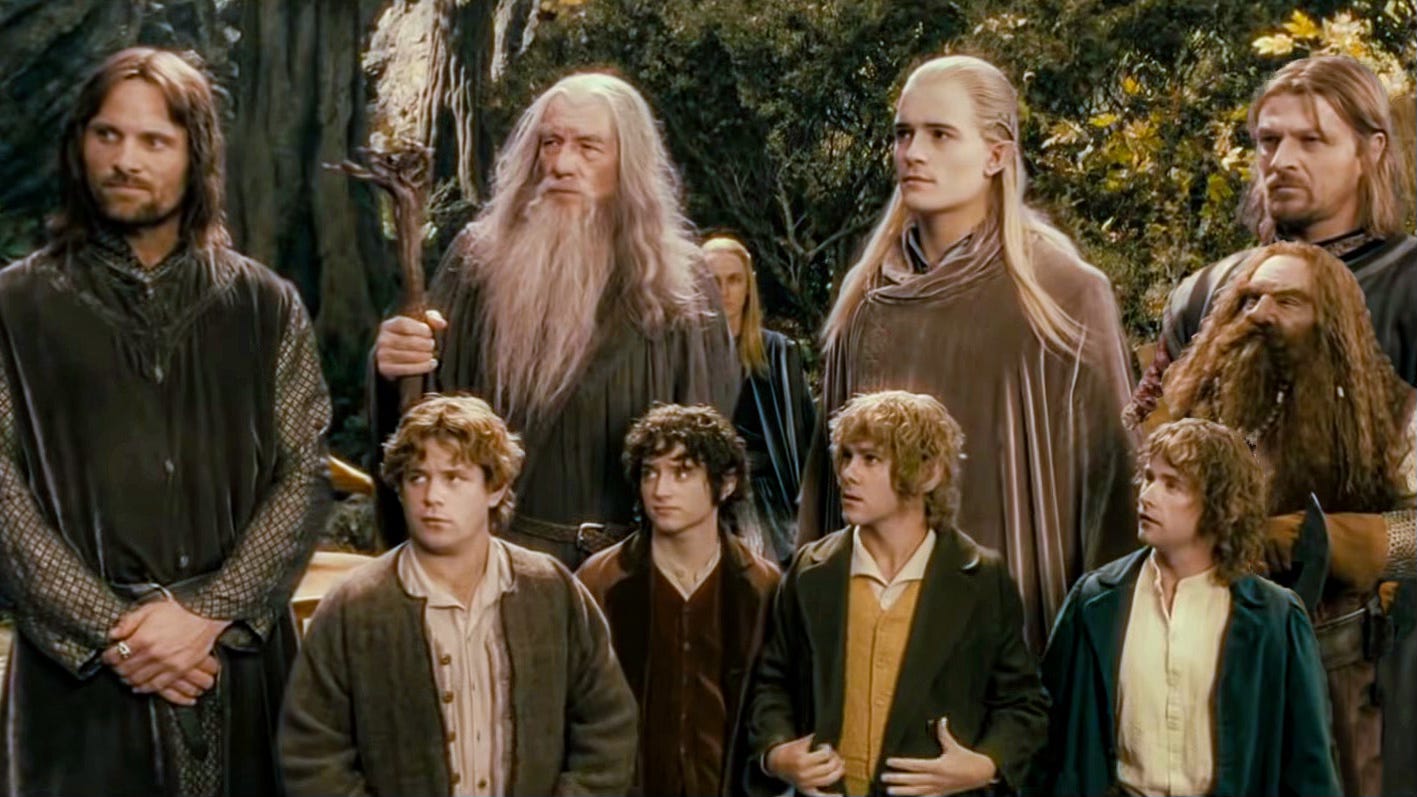
I believe in muses—but not in the pagan sense of capricious goddesses whispering poetry into the ears of artists. I believe, rather, in something far more concrete and metaphysical: that angels, as ministering intelligences, can prompt, illuminate, and stir the human imagination. Not by overriding human freedom or inserting secret messages, but by assisting the intellect and imagination in ways proper to their nature1. St. Thomas Aquinas teaches that angels can act upon the human intellect indirectly, by enlightening the imagination and presenting intelligible forms for the mind to work with (Summa Theologiae I, q.111, a.1; q.114, a.1). In other words, inspiration need not be mystical or mythical to be real2. Sometimes I encounter films and stories with theological depth so precise, so uncommon, so resonant with Christian truth, that it seems impossible to attribute it to coincidence—despite the fact that their creators were not trained theologians. The movie The Avengers comes to mind, though that is a reflection for another time.
In the case of The Lord of the Rings, however, we are on firmer ground. J.R.R. Tolkien was not merely influenced by Christianity as a cultural background; his Catholic faith was a wellspring—formed by prayer, tradition, philosophy, and a sacramental view of reality—that quietly shaped the world he created. The result is not allegory or mere moralism, but something much richer: a vision of reality marked by sacrifice, mercy, temptation, humility, hope and heroism. The theology is woven into the story without being announced or spotlighted, so you have to be paying attention to catch it. Having recently completed The Lord of the Rings for the first time, I want to share a series of particularly powerful passages that reveal just how Christian this story really is, and how intense, and beautiful its vision of the world can be when read with open eyes.
1. “Even the smallest person can change the course of the future.”
— Galadriel, Book II, Chapter 8 (“Farewell to Lórien”)
Catholic Reflection:
This mirrors the Gospel theme that God delights in working through the small and humble. Like Mary, the “handmaid of the Lord,” or David the shepherd boy, or the “stupid” St. Therese of Lisieux greatness in God’s eyes is not measured by power but by faith and humility—even smallness. It reminds us that sanctity is accessible to everyone. Even the least likely souls can be instruments of grace.
2. “Faithless is he that says farewell when the road darkens.”
— Gimli, Book II, Chapter 3 (“The Ring Goes South”)
Catholic Reflection:
This is the courage of the saints-fidelity in trial. True faith perseveres when the light fades. It calls to mind Christ’s words: “He who endures to the end will be saved” (Matthew 24:13). To be faithful when it’s easy is ordinary; to be faithful when the road darkens is sanctity. It’s heroic virtue.
3. “There is some good in this world, and it’s worth fighting for.”
— Samwise Gamgee (in the film adaptation, but reflecting his spirit in the book)
Catholic Reflection:
Sam expresses the Catholic hope rooted in redemption. Despite sin and darkness, creation remains good, because it was made by God and redeemed by Jesus Christ. The Christian life is not an escape from the world but a mission to defend and restore the good within it, through charity, truth, and sacrifice.
4. “The world is indeed full of peril, and in it there are many dark places; but still there is much that is fair, and though in all lands love is now mingled with grief, it grows perhaps the greater.”
— Haldir of Lórien, Book II, Chapter 6 (“Lothlórien”)
Catholic Reflection:
This is a profoundly incarnational insight! Even in a fallen world, beauty and love endure. When love endures sorrow and suffering, it is purified of self-interest and begins to resemble the love of God. Just as the Cross transformed suffering into redemption, so love mixed with grief can grow greater in holiness.
5. “I wish it need not have happened in my time,” said Frodo.
“So do I,” said Gandalf, “and so do all who live to see such times. But that is not for them to decide.”
— Book I, Chapter 2 (“The Shadow of the Past”)
Catholic Reflection:
This is a lesson in accepting divine providence — a trust that echoes Christ’s agony in Gethsemane: “Not my will, but Yours be done.” We don’t choose the times we live in, but we are called to be faithful within them. Sanctity is not about timing — it’s about obedience and courage. Each of us is here—int his time and place—on purpose, with purpose.
6. “May it be a light to you in dark places, when all other lights go out.”
— Galadriel to Frodo, Book II, Chapter 8 (“Farewell to Lórien”)
Catholic Reflection:
The Phial of Galadriel symbolizes the light of grace — the presence of Christ, “the light that shines in the darkness” (John 1:5). When worldly lights fail — when comforts, plans, or certainties collapse — grace endures. It is the sacramental light we carry in our souls through baptism and the Eucharist. Your “Phial” may come to life through the Rosary or other prayers and devotions. It may be the mass, or Eucharistic adoration. It may sometimes be only the knowledge and faith that God is with you, even when you can’t “feel” Him.
Follow me on socials X | Insta | TikTok | YouTube | Facebook | Discord
FOOTNOTES
St. Thomas Aquinas explains that angels do not act directly upon the human intellect, which is ordered to truth under God alone, but can influence human cognition indirectly by acting upon the imagination and sensory powers. See Summa Theologiae I, q.111, a.1.
Aquinas further teaches that angels can move human beings toward action by proposing images or thoughts to the imagination, while leaving the will free to accept or reject them. This influence does not compromise human freedom. See Summa Theologiae I, q.114, a.1.


Love this
Loved the take on Haldir's quote about love mingeld with grief growing greater. That incarnational reading is spot on, most poeple miss the theological weight baked into Tolkien's descriptions of beauty-in-sorrow. I've been rereading LOTR lately with a philosophy friend, and we noticed the way providence shows up is almost Boethian, like consolation through constrained choice rather than optimism.